
Buffered coco peat, made to a lab-tested specification
Coco peat holds sodium and potassium that can upset your nutrient balance. We wash and buffer it with calcium so it arrives stable, and we test every lot.
- EC (buffered)
- < 0.3 mS/cm
- Sodium (Na)
- < 100 ppm
- Potassium (K)
- < 270 ppm
- Expansion
- 18 L/kg
- Moisture
- < 20 %
Na and K by BaCl₂ extraction. Custom Na/K levels on request.
Why buffering matters
Coco peat has a high cation exchange capacity. Straight from the husk, its exchange sites carry sodium and potassium. In the greenhouse it releases them and takes up calcium and magnesium from your feed, which can cause deficiencies and EC drift in young plants.
Buffering makes that exchange before shipping. Calcium replaces sodium and potassium on the exchange sites, the released salts are washed out, and the substrate behaves predictably from the first irrigation.
How we buffer
Every step runs in our own facility, with lab checks before the peat is pressed.
Wash
Fresh coco peat is washed to bring EC down.
Buffer
Calcium nitrate solution is sprayed over the piles in repeated spray-and-turn cycles.
Dry
The peat is sun-dried on our concrete yard to below 20 % moisture.
Test
Our lab measures EC, pH, sodium and potassium on samples from each lot.
Press and pack
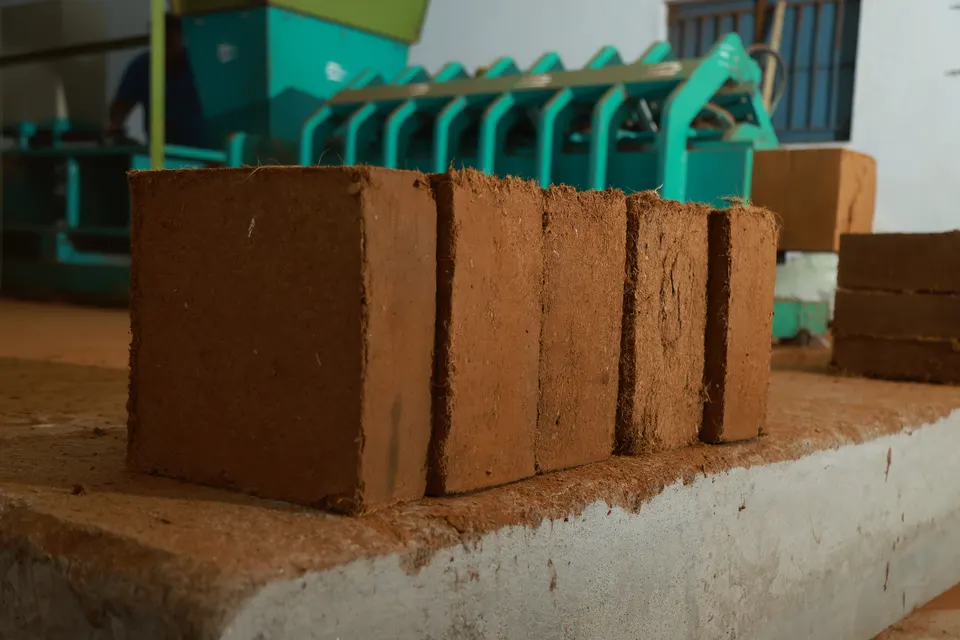
Approved peat is pressed into 5 kg blocks or filled into grow bags, then palletised.
Need a different Na or K level?
Tell us your crop and target values. Our in-house lab adjusts the buffering and confirms the result before your order is pressed.
- Custom sodium and potassium targets
- Low EC washed and high EC grades also available
- Certificate of analysis with every shipment
Buffered and tested in our in-house lab to RHP-guideline parameters (EC, pH, Na, K). Custom Na and K levels on request.
Used for
- Greenhouse tomatoes
- Cucumbers and peppers
- Strawberries and berries
- Nursery propagation
- Potting mixes
- Hydroponic systems
Questions buyers ask
What is the difference between washed and buffered coco peat?
Washing removes free salts and lowers EC. Buffering goes further: calcium replaces the sodium and potassium held on the exchange sites, so the peat will not pull calcium and magnesium from your nutrient solution.
Can you meet our own Na and K specification?
Yes. Share your targets and our in-house lab will buffer and test to them. The certificate of analysis for your lot shows the measured values.
What EC does your buffered coco peat have?
Below 0.3 mS/cm on our standard buffered grade.
How much does a 5 kg block expand?
About 18 litres per kilogram, so roughly 90 litres per 5 kg block after full hydration.
Which test method do you use for Na and K?
Sodium and potassium are reported using barium chloride (BaCl₂) extraction. Third-party analysis from NABL-accredited laboratories is available on request.
Can we get a sample first?
Yes. Request a sample with your delivery address and we will courier it with the paperwork your country requires.
Tell us what you need
Send a purchase order and get prices within 24 hours, or ask for a sample first.